Understanding fit
Fit answers one question: where does a school sit relative to you? CollegeVerge shows it two ways, and they deliberately measure different things. The fit category is a badge (Likely, Target, Reach, or Far reach) that reads your admission odds: how likely an admit looks given your academics and the school's selectivity. The profile match is a 0–100 ring that reads alignment: how closely the school lines up with the academics, budget, and preferences you set, from up to four signals: academic, financial, athletic, and your stated preferences. A school can match your profile closely and still be a Far reach to get into; that is not a contradiction, it is the two reads doing their separate jobs.
A fit badge orients you on where a school stands relative to your profile and helps you balance a list. It is not an admit or deny forecast. Numbers are one input, and the rest of your application, your essays, activities, and recommendations, still carries real weight.
The fit category
The category is student relative. The same school can read as a Target for one applicant and a Far reach for another, because the badge compares your academics against both the school's admitted profile and how selective it is.
Your academic standing
CollegeVerge blends two signals into a single read of where you stand:
- Test signal (60%). Where your SAT or ACT falls against the school's middle 50%, the band between its 25th and 75th percentiles. At or above the 75th reads as strong, inside the band reads as in line, and below the 25th reads as below. If you go test optional or have no scores on file, there is no test signal.
- GPA signal (40%). Your unweighted GPA on a 4.0 scale against the school's average admitted GPA. At or above that average is strong, roughly even is in line, and meaningfully under is below. We do not use weighted GPA, because a 5.0-scale weighted number is not comparable to the admitted averages schools report. A strong GPA can lift a borderline test score, and it still counts when you apply test optional.
If only one signal exists, that one is used. If neither exists, your academic standing is unknown. The blend collapses into three bands: at or above the admitted profile, in line with it, or below it.
Selectivity tiers
The other axis is how selective the school is, set by its acceptance rate:
| Tier | Acceptance rate |
|---|---|
| Accessible | Over 50% |
| Selective | 25–50% |
| Very selective | 10–25% |
| Most selective | Under 10% |
The matrix
Your academic standing meets the school's selectivity, and the cell where they cross is your category:
| Your academics | Most selective (under 10%) | Very selective (10–25%) | Selective (25–50%) | Accessible (over 50%) |
|---|---|---|---|---|
| At or above the admitted profile | Far reach | Target | Likely | Likely |
| In line with the admitted profile | Far reach | Reach | Target | Likely |
| Below the admitted profile | Far reach | Far reach | Reach | Target |
The most-selective rule
Every school in the Most selective column reads as Far reach, no matter how strong your stats are. The Ivy League, MIT, Stanford, Caltech, and any school admitting under 10% are always Far reach, because admission there is holistic and is never guaranteed by scores and grades alone. Essays, activities, and recommendations decide far too much for a number to promise a seat. Including one or two of these is reasonable; building a list out of them is not.
Just above that line, schools admitting between 10 and 15 percent cap at Reach even for a strong profile. Admission that selective is competitive for everyone, and the cap keeps a school at 10.1% from reading two full categories friendlier than one at 9.9%. The in-state public boost below can still move a credible in-state applicant one step up from there.
The in-state public boost
If you are an in-state applicant to a public university and you are academically credible, in line with the admitted profile or above, you get a modest nudge one category more favorable, say from Reach to Target. It reflects the better admit odds in-state applicants tend to see at their state schools. The nudge never promotes a below-profile applicant, and it never applies to private schools or out-of-state publics. Your in-state status also changes the affordability read, since we cost the school at the in-state price.
Test-optional handling
If you apply test optional and have no usable academic signal at all, the category leans on the acceptance rate alone: over 60% reads as Likely, 25–60% as Target, and under 25% as Reach. But if you have a GPA on file, that GPA still drives an academic read, so going test optional does not flatten the badge as long as your grades are there.
How it plays out
A few concrete cases make the student-relative logic clearer:
- Strong stats at a flagship. A 1600 SAT at a selective public flagship lands as a Target, not a Reach. Because the applicant's academics sit at or above the admitted profile, the matrix reads across the top row, and a selective school there is a Target. Strong numbers genuinely move schools toward Target and Likely instead of leaving every selective school stuck at Reach.
- A different applicant, same flagship. An applicant whose academics fall below that flagship's admitted profile lands as a Far reach at the very same school. Nothing about the school changed. The badge is relative to who is reading it.
- A GPA that does the lifting. Say your test scores sit inside a school's middle 50%, which on its own reads as in line, but your unweighted GPA is above the school's admitted average. The GPA blends your standing upward, and a school that would have read as a Reach can land as a Target.
- In-state versus out-of-state. Two applicants with the same profile look at the same public university. The in-state applicant gets the modest nudge and sees the in-state price in the affordability read. The out-of-state applicant gets neither, so the same school can sit one category apart for the two of them.
A list weighted toward Targets, anchored by a couple of Likelies, and topped with only one or two Far reaches will serve you better than a stack of long shots. The badges exist to help you find that balance, not to rule schools in or out.
The profile match ring
Alongside the badge, each school shows a profile match from 0 to 100. Where the badge reads your admission odds, the ring reads alignment: how well the school lines up with the profile you built, folding in cost, your stated preferences, and, for athletes, your sport. The dashboard and each school's full record break the number into labeled bars, one per component, each with a plain-language line explaining what drove it. Parents see the same breakdown on the read-only record in the parent portal. It draws on up to four components.
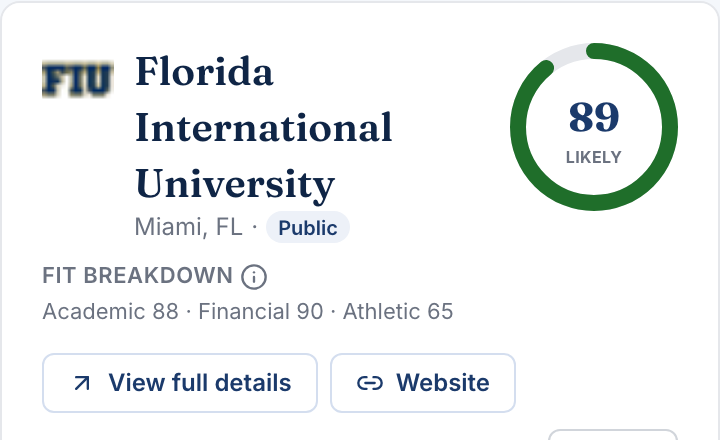
- Academic. Built from the same signals behind the badge, but continuous: the score reflects exactly where your SAT or ACT sits across the school's middle 50% and how far your GPA sits from the admitted average, so raising a score or a grade moves the number smoothly instead of in big jumps. When there is no academic signal, the score is approximated from the school's selectivity, so more selective schools still read differently from accessible ones.
- Financial. The school's cost against the annual budget you set, sliding down gradually as cost runs past budget rather than dropping in steps. For an in-state student at a public university, we use the in-state price. For an out-of-state student at a public we use the out-of-state sticker price, because the average net price publics report mostly reflects in-state students and would paint too rosy a picture. When budget or cost data is missing, this component is simply not shown.
- Athletic. This one is lift only and division aware. It appears only for athletes whose sport the school actually sponsors. Being sponsored at the division you are targeting scores highest, and being sponsored at a different level still helps, just less. It can raise the ring but never lower it, and aiming at a division below the school's level never counts against you. When it does not apply, it is absent, with no penalty.
- Preferences. How the school lines up with the preferences you set during onboarding: region, school size, and public versus private, plus your intended major when it is among the school's most popular programs. The major signal is positive only, since a school can be strong in a major that simply is not among its biggest. Preferences you did not set, and school facts we do not have, are skipped rather than counted against the school. If you set no preferences at all, this component is absent.
The ring weights academic most heavily, then financial, then preferences, then athletic when it is present, and it always takes the more favorable of the with-athletics and without-athletics blends. That is why a strong recruit never sees their ring dip because of their sport.
What you see on each plan
The fit badge is on every plan, Free included, so you can balance a list from day one. The plain-language explanation of how a score was built is on Standard. The AI-written rationale that walks through the why, in full sentences tailored to the school and your profile, is on Premium.